
MEPCO Peak Hours 2026: Timing, Rates and How to Save
MEPCO peak hours are the four evening hours of each day when electricity costs more for consumers who have a Time of Use (ToU) meter. The timing changes with the season: 5 PM to 9 PM in winter, 6 PM to 10 PM in spring and autumn, and 7 PM to 11 PM in summer. The remaining 20 hours of the day are off-peak hours, when each unit is cheaper.
This guide gives the month-wise timing, explains which connections are actually billed on peak and off-peak rates, and shows how to shift your usage to lower the bill.
In this guide:
- MEPCO peak hours timing 2026
- Do peak hours apply to your connection?
- How to check peak and off-peak units on your bill
- Peak and off-peak unit rates
- How to reduce your bill during peak hours
- Peak units look wrong on your bill?
- Frequently asked questions
MEPCO Peak Hours Timing 2026
Peak hours are not chosen by MEPCO itself. They are set by NEPRA, the national power regulator, in the tariff terms and conditions, and the same schedule is followed by every distribution company. The current timing is:
| Months | Season | Peak hours | Off-peak hours |
|---|---|---|---|
| December to February | Winter | 5:00 PM to 9:00 PM | Remaining 20 hours |
| March to May | Spring | 6:00 PM to 10:00 PM | Remaining 20 hours |
| June to August | Summer | 7:00 PM to 11:00 PM | Remaining 20 hours |
| September to November | Autumn | 6:00 PM to 10:00 PM | Remaining 20 hours |
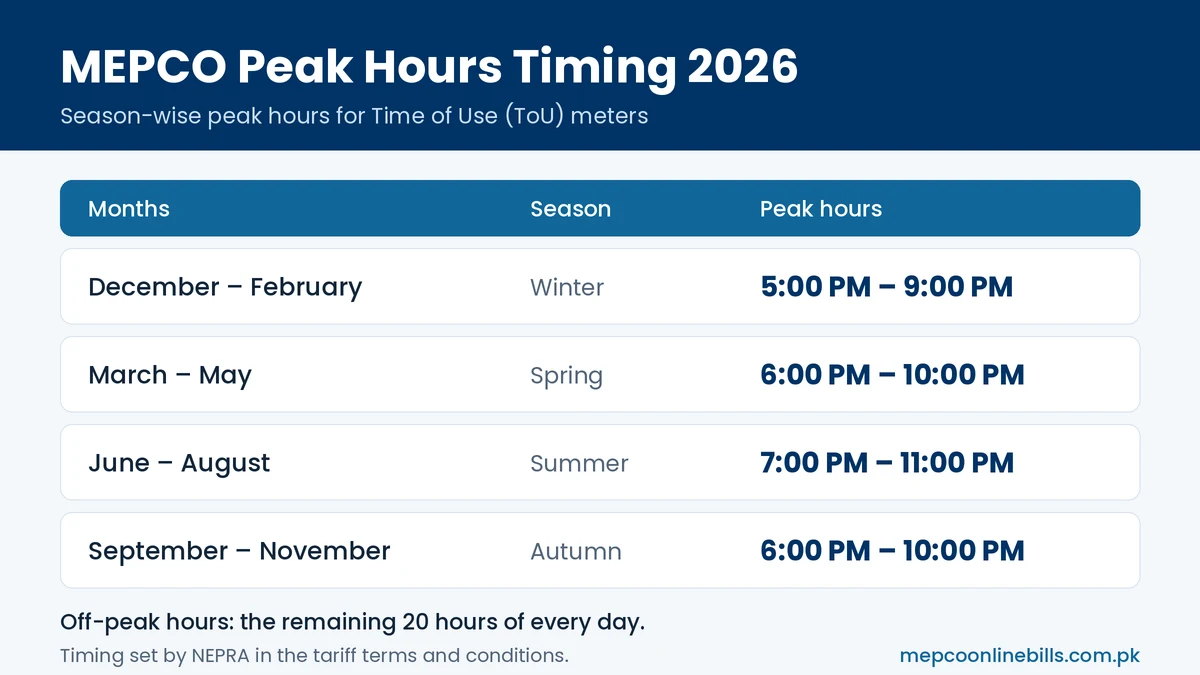
So in October and November the peak window is 6 PM to 10 PM, and from 1 December it moves one hour earlier, to 5 PM to 9 PM. The window is always four hours long. Only the start time shifts, because evening demand begins earlier when the sun sets earlier.
Do Peak Hours Apply to Your Connection?
This is the part most people miss. Peak and off-peak rates apply only to connections that are billed on the Time of Use tariff. As a rule, that means a sanctioned load of 5 kW or more, which usually comes with a three-phase meter. It covers:
- larger homes with a sanctioned load of 5 kW or above (tariff A-1(b))
- shops, offices and other commercial connections of 5 kW or above
- industrial connections and agricultural tube wells that have a ToU meter
If you have an ordinary single-phase domestic meter with a load below 5 kW, your bill is calculated on slabs, from the total units used in the month. A unit used at 8 PM costs you the same as a unit used at 8 AM. For this type of connection the monthly total matters more than the clock, and you can estimate it in advance with our MEPCO bill calculator.
How to Check Peak and Off-Peak Units on Your Bill
You do not have to guess which tariff you are on. Your bill shows it:
- Open your latest bill with the MEPCO bill check tool by entering your 14-digit reference number.
- Look at the tariff and the sanctioned load printed in the top part of the bill.
- Check the units section. A Time of Use bill lists peak units and off-peak units separately, each with its own rate. A slab bill shows a single total of units.
If the paper bill is lost, you can download a fresh copy by following our MEPCO duplicate bill guide. If you do not know the reference number either, see how to find your reference number with your CNIC.
MEPCO Peak and Off-Peak Unit Rates
For residential Time of Use consumers, the base rates under NEPRA’s tariff decision of February 2026 are:
| Charge | Rate |
|---|---|
| Peak hours | Rs 46.85 per unit |
| Off-peak hours | Rs 34.53 per unit |
| Fixed charge | Rs 675 per kW per month |
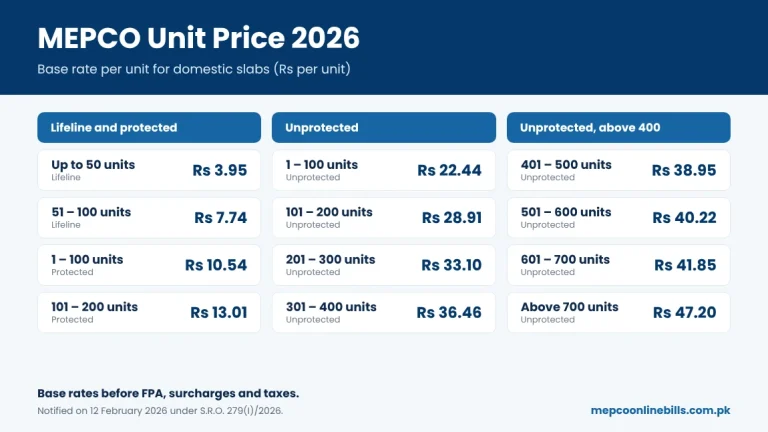
A peak unit therefore costs Rs 12.32 more than an off-peak unit, which is about 36% extra. These are base rates. Taxes, the monthly fuel price adjustment and the quarterly adjustment are added on top, so the final cost per unit on your bill is higher. Commercial, industrial and agricultural connections have their own peak and off-peak rates. For the full official schedule, see the Tariff Structure page on the official MEPCO website or the MEPCO tariff page on the NEPRA website.
A quick example: suppose your water motor, washing machine and iron together use 3 units every evening during peak hours. Moving that work to the afternoon saves 3 × Rs 12.32 = Rs 36.96 a day, which is roughly Rs 1,100 a month before taxes.
How to Reduce Your Bill During Peak Hours
If your bill shows peak units, the aim is simple: move every load that does not have to run in the evening out of the peak window.
- Run heavy appliances earlier. Use the water motor, washing machine, iron and oven before the peak window starts.
- Cool the room in advance. Start the air conditioner before peak hours begin, then set it to 26°C and keep the doors closed so it works less during the costly hours.
- Put the geyser on a timer. In winter, heat water in the afternoon instead of between 5 PM and 9 PM.
- Charge during off-peak hours. UPS batteries, electric bikes and power banks can charge late at night or in the daytime.
- Use sunlight hours if you have solar. Run heavy loads while the panels are producing, so fewer units are drawn from the grid in the evening.
- Update your routine each season. A habit that avoids 7 PM to 11 PM in summer has to change to 6 PM to 10 PM from September.
To see whether the changes are working, compare your peak units month by month. Our MEPCO old bill check guide explains how to view the bill history of previous months.
Peak Units Look Wrong on Your Bill?
Sometimes the peak units look too high, or a home with a load below 5 kW is billed on the Time of Use tariff. Before the due date:
- note the peak and off-peak readings on your meter and compare them with the readings printed on the bill
- check the time shown on the meter display, because a meter clock that is out of time can record off-peak usage as peak usage
- take a clear photo of the meter as proof
Then report the problem to your sub-division office or the helpline. The numbers and the online method are listed in our MEPCO complaint number guide. Once the bill is settled, you can pay it from your phone with any of the MEPCO bill payment methods.
Frequently Asked Questions
What are the MEPCO peak hours today?
It depends on the month. Peak hours are 5 PM to 9 PM from December to February, 6 PM to 10 PM from March to May and from September to November, and 7 PM to 11 PM from June to August.
Do peak hours apply to a single-phase domestic meter?
Normally no. Connections below 5 kW are billed on slabs, so the time of use does not change the rate. Peak rates apply to connections on the Time of Use tariff.
Are MEPCO peak hours the same on Sunday?
Yes. NEPRA’s schedule lists no exemption for Sundays or public holidays, so the same four hours apply every day.
What is the MEPCO peak hour unit rate?
For residential Time of Use consumers the base rate is Rs 46.85 per unit in peak hours and Rs 34.53 per unit in off-peak hours, before taxes and adjustments.
Are peak hours and load shedding the same thing?
No. Peak hours are a billing rule, and the supply continues as normal during them. Load shedding is an interruption of supply and follows a separate schedule.



One Comment